Football Formations Guide: From 4-4-2 to Today’s Tactical Systems
Football is a beautifully fluid game, but beneath the magic on the pitch lies a complex, intellectual chess match of tactical structures. If you want to truly master the strategic side of the sport, this Football Formations Guide: From 4-4-2 to Today’s Tactical Systems is your ultimate resource. From the classic flat banks of four to the modern, highly fluid configurations used by elite tacticians, understanding how teams arrange themselves is essential. In this deep dive, we will explore historical shifts, structural mechanics, and the tactical innovations that define the modern game.
Table of Contents
- Why You Need a Comprehensive Football Formations Guide: From 4-4-2 to Today’s Tactical Systems
- The Foundation: The Classic 4-4-2 System
- The Evolution of the Dominant 4-3-3 Shape
- The Pragmatic Balance: Demystifying the 4-2-3-1
- The Renaissance of Three-at-the-Back (3-5-2 and 3-4-3)
- Modern Fluidity and Hybrid Tactical Systems
- Tactical Formations Comparison Table
- Conclusion and Tactical Takeaways
- Frequently Asked Questions (FAQ)
Why You Need a Comprehensive Football Formations Guide: From 4-4-2 to Today’s Tactical Systems
Formations are much more than static numbers on a television graphic. Instead, they represent a team’s framework for space creation, defensive solidity, and transition management. By reading this Football Formations Guide: From 4-4-2 to Today’s Tactical Systems, you will begin to see how structures dictate player behavior and ball progression.
Furthermore, contemporary football has evolved beyond rigid positioning. Today, a team might defend in a compact 4-4-2 block but transition into a highly attacking 3-2-5 shape during possession. Consequently, analyzing these patterns is what makes this Football Formations Guide: From 4-4-2 to Today’s Tactical Systems so valuable for coaches, analysts, and passionate fans alike.
The Foundation: The Classic 4-4-2 System
For decades, the flat 4-4-2 was the undisputed king of football formations, particularly in the English Premier League. This system prioritizes balance, symmetrical spacing, and simplicity, making it exceptionally easy for players to learn and execute.
The Structural Mechanics of the 4-4-2
In a standard 4-4-2, the team is divided into three distinct lines: four defenders, four midfielders, and two central strikers. Typically, one striker acts as a target man (the physical presence), while the second striker plays as a creative “second striker” or “number 10” operating in the spaces just behind.
Moreover, the wide midfielders are expected to deliver crosses into the box while also tracking back to assist their respective full-backs. The central midfield duo must be highly disciplined, balancing defensive screening duties with late attacking runs.
Strengths and Weaknesses of the 4-4-2
- Strength: Exceptional pitch coverage and natural defensive partnerships across the entire field.
- Strength: Direct attacking options with two strikers consistently occupying opposition center-backs.
- Weakness: Highly vulnerable to being outnumbered in central midfield when playing against three-man midfield setups.
- Weakness: Can become incredibly rigid, making it easy for fluid opposition teams to bypass via half-spaces.
Historically, teams like Arrigo Sacchi’s legendary AC Milan and Sir Alex Ferguson’s 1999 treble-winning Manchester United utilized variations of this system to dominate Europe. Even in modern times, defensive masterminds like Diego Simeone at Atlético Madrid have adapted the 4-4-2 into a compact, low-block defensive masterclass.
The Evolution of the Dominant 4-3-3 Shape
As central midfields became increasingly congested, coaches realized that numerical superiority in the center of the pitch was key to controlling games. Subsequently, this realization paved the way for the rise of the 4-3-3 formation, a system heavily popularized by Dutch “Total Football” and refined by Pep Guardiola.
Historical Evolution: A Football Formations Guide: From 4-4-2 to Today’s Tactical Systems Analysis
By dropping one striker from the traditional 4-4-2 and adding an extra midfielder, the 4-3-3 creates natural passing triangles all over the pitch. This structural shift is a prime focal point of our historical analysis, showcasing how managers prioritized possession over direct play.
Within the 4-3-3, the three-man midfield consists of a deep-lying defensive playmaker (the single pivot) and two dynamic central midfielders (the “8s”). Up front, wide wingers cut inside or hug the touchlines, supported by a central striker who may drop deep as a “false nine” to create further numerical overloads in the midfield.
Key Tactical Elements of the 4-3-3
To fully grasp the 4-3-3, it is useful to reference tactical databases like The Coaches’ Voice, which dissects how modern managers use this shape. Crucial elements include:
- Passing Triangles: The natural positioning of the players creates continuous diagonal passing lanes, rendering direct vertical passes safer and more effective.
- High Pressing: The presence of three forward players allows teams to execute an aggressive high press, locking opposition teams into their own defensive thirds.
- Inverted Wingers: Modern wingers in a 4-3-3 frequently play on the opposite side of their dominant foot, allowing them to cut inside and shoot, while full-backs overlap to provide width.
The Pragmatic Balance: Demystifying the 4-2-3-1
During the late 2000s and early 2010s, the 4-2-3-1 emerged as the most widely used tactical system in world football. It was designed to counter the possession dominance of the 4-3-3 while retaining a potent attacking threat.
The Role of the Double Pivot
At the heart of the 4-2-3-1 are the two defensive midfielders, commonly referred to as the “double pivot.” Typically, this duo consists of a defensive destroyer who breaks up plays, paired with a deep-lying playmaker who orchestrates transitions from the back.
Therefore, this double pivot provides a secure defensive screen, allowing the front four players absolute creative freedom. The central attacking midfielder (the classic “number 10”) acts as the primary playmaker, pulling strings in the final third and linking up with the lone striker.
Why Managers Love the 4-2-3-1
This tactical structure offers an incredibly smooth transition between defense and attack. When defending, the wingers drop back to form a solid 4-4-1-1 or 4-5-1 block. Conversely, when attacking, the system quickly transforms into a highly threatening 2-4-4, with the full-backs pushing high and wide to overload the opposition wings.
The Renaissance of Three-at-the-Back (3-5-2 and 3-4-3)
Tactical trends are cyclical. As a result of teams getting comfortable defending against four-back systems, innovative managers revived three-at-the-back systems to create structural overloads in wide areas and defensive solidity in the box.
The Contemporary Landscape: Football Formations Guide: From 4-4-2 to Today’s Tactical Systems in Action
If we look closely at this Football Formations Guide: From 4-4-2 to Today’s Tactical Systems in action, the 3-5-2 and 3-4-3 systems stand out as masterclasses in adaptability. The defining feature of these formations is the wingback role.
Wingbacks must possess elite stamina, as they are solely responsible for providing width in attack while dropping back to form a five-man defense when the team is out of possession. Consequently, these systems offer a unique blend of defensive resilience and attacking numbers.
For a detailed breakdown of how professional academies teach these positioning structures, resources like the FIFA Training Centre offer invaluable instructional material. Their tactical insights show how three-back systems dominate central spaces while preventing counter-attacks.
Comparing 3-5-2 vs. 3-4-3
While both formations use three central defenders, their attacking structures are fundamentally different:
- The 3-5-2: Features a dense, three-man central midfield with two central strikers. This setup is highly effective for controlling the tempo of the game and playing through the middle.
- The 3-4-3: Deploys two central midfielders and a dynamic front three. This shape creates massive overloads on the wings, allowing wingbacks and wide forwards to isolate opposition full-backs.
Modern Fluidity and Hybrid Tactical Systems
In today’s elite football, formations are incredibly dynamic. Managers like Pep Guardiola, Mikel Arteta, and Roberto De Zerbi rarely instruct their teams to stay in their starting paper formations. Instead, they use fluid hybrid shapes that shift entirely based on who has the ball.
The Rise of the 3-2-4-1 Shape
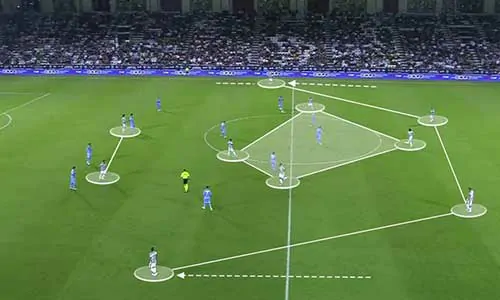
A prominent modern innovation is the 3-2-4-1 build-up shape. When starting a match, the team may look like a standard 4-3-3. However, during possession, one of the full-backs (or even a center-back like John Stones) steps forward into the midfield to create a double pivot.
This tactical adjustment creates a highly structured 3-2-4-1 setup, consisting of three central defenders, a box midfield of four players, two wide wingers, and a lone central striker. Consequently, this box midfield provides total control over the center of the pitch, making it almost impossible for the opposition to mount counter-attacks.
The Concept of Rest Defense
In modern tactical systems, “rest defense” is of paramount importance. This term refers to how a team structures its defensive players while they are still in possession of the ball. By maintaining a compact rest defense shape (such as a 3-2 structure at the back), teams can instantly press and win the ball back the moment they lose it, preventing dangerous counter-attacks before they even begin.
Tactical Formations Comparison Table
To help you visualize these differences easily, we have compiled a comparative overview of the most prominent setups analyzed in this tactical guide:
| Formation | Key Strengths | Primary Vulnerability | Famous Example Team |
|---|---|---|---|
| 4-4-2 | Symmetrical pitch coverage, strong defensive partnership. | Easily outnumbered in central midfield. | Manchester United (1998/99) |
| 4-3-3 | Excellent passing triangles, high-pressing efficiency. | Leaves space behind overlapping full-backs. | FC Barcelona (2008/09) |
| 4-2-3-1 | Strong defensive screen, highly flexible attacking transitions. | Relies heavily on an elite, creative playmaker. | Real Madrid (2011/12) |
| 3-5-2 | Overloads central spaces, strong defensive box coverage. | Demands physically elite, high-stamina wingbacks. | Inter Milan (Antonio Conte era) |
| 3-2-4-1 (Hybrid) | Total midfield dominance, excellent rest defense structure. | Highly complex; susceptible to quick, direct wing counters. | Manchester City (2022/23) |
Conclusion and Tactical Takeaways
As we have explored in this Football Formations Guide: From 4-4-2 to Today’s Tactical Systems, tactical frameworks are living, breathing concepts. No single formation is universally superior; instead, success depends on how well a system utilizes the strengths of the players on the pitch and counters the weaknesses of the opposition.
Therefore, whether you are analyzing a Champions League final or coaching a local youth squad, understanding these tactical shifts allows you to see the beautiful game in a whole new light. The journey from the simplicity of the 4-4-2 to the fluid, complex structures of modern hybrid systems proves that football is an ever-evolving sport.
What is your favorite tactical system?
Do you prefer the balance of a classic 4-3-3 or the fluid control of modern hybrid systems? Leave a comment below and share your tactical insights with us!
Frequently Asked Questions (FAQ)
Q1: What is the most successful formation in modern football history?
There is no single “most successful” formation. However, the 4-3-3 and the 4-2-3-1 have been the most widely used and successful configurations over the past two decades, offering a perfect balance of possession control and defensive stability.
Q2: Why did teams stop using the flat 4-4-2 formation?
As opponents shifted to three-man midfielders (like in the 4-3-3), teams playing a flat 4-4-2 found themselves heavily outnumbered in the middle of the pitch. This made it difficult to retain possession and control the tempo of matches.
Q3: What does an “inverted fullback” mean in modern tactics?
An inverted fullback is a defender who starts in a wide position but moves inside to play as a central midfielder when their team has the ball. This tactic creates numerical superiority in midfield and helps prevent central counter-attacks.
Q4: What is the difference between a 3-5-2 and a 5-3-2 formation?
The difference lies primarily in mentality and positioning. A 3-5-2 is an attacking shape where the wingbacks play high up the pitch as midfielders. A 5-3-2 is a defensive, low-block shape where the wingbacks sit deep alongside the center-backs to form a flat defensive line of five.
Q5: How do hybrid formations work in possession phases?
In a hybrid setup, players have different roles depending on whether their team has the ball. For example, a team might defend in a compact 4-4-2 shape, but when they win the ball, a fullback moves into midfield, transforming the shape into an attacking 3-2-4-1 configuration.
Q6: Why is the “number 10” role disappearing in modern football?
Traditional static playmakers who only attack have struggled because modern football demands extreme physical pressuring and defensive work. Most modern managers now prefer dynamic “box-to-box” midfielders (8s) who contribute to both phases of the game.