FIFA World Cup Host Selection Process: Evolution Through the Years
The FIFA World Cup is the pinnacle of international football, drawing billions of viewers every four years. However, the drama is not confined solely to the pitch. The race to secure hosting rights is a saga filled with geopolitical rivalry, economic ambition, and structural reforms. Consequently, understanding the FIFA World Cup host selection process reveals how the tournament evolved from an informal European agreement into a highly regulated global bidding war.
Historically, the decision-making process was characterized by closed-door agreements and political influence. Over the decades, public scrutiny and governance crises forced football’s governing body to implement sweeping changes. In this comprehensive guide, we explore the FIFA World Cup Host Selection Process: Evolution Through the Years, highlighting how the bidding system transitioned from a secret ballot of a select few to a transparent, points-based democratic vote.
Table of Contents
- 1. The Genesis of World Cup Bidding (1930–1954)
- 2. Understanding the FIFA World Cup Host Selection Process: Key Milestones
- 3. Reforms and Transparency in the FIFA World Cup Host Selection Process
- 4. How the Modern FIFA World Cup Host Selection Process Combats Corruption
- 5. Human Rights, Sustainability, and Technical Audits
- 6. The Future: Multi-Nation Bidding and Global Expansion
- 7. Bidding Requirements Comparison: Past vs. Present
- 8. Frequently Asked Questions (FAQ)
1. The Genesis of World Cup Bidding (1930–1954)
In the early days of international football, choosing a host country was an informal affair. When FIFA decided to launch the inaugural World Cup in 1930, Uruguay was selected as the host. This decision was primarily a reward for their consecutive Olympic titles in 1924 and 1928. Furthermore, Uruguay offered to cover all travel and accommodation expenses for participating teams, which was a crucial incentive during the global depression.
However, travel limitations presented significant challenges. Many European countries refused to make the arduous two-week sea voyage across the Atlantic. Consequently, only four European teams participated in the 1930 tournament. This boycott highlighted the need for a more structured approach to host selection, though progress remained slow.
For the next few tournaments, choices were heavily influenced by political lobbying and geographical convenience. In 1934, Italy was selected to host after a prolonged lobbying campaign by its government. In 1938, France was chosen, which broke the unwritten agreement of alternating the tournament between Europe and South America. This decision angered South American nations, prompting Argentina and Uruguay to boycott the tournament entirely.
As a result, World War II caused a twelve-year hiatus in the tournament. When the competition resumed in 1950, Brazil was chosen unopposed because Europe was still rebuilding from the war. Thus, this laid the early foundation for how the FIFA World Cup host selection process would function under shifting global conditions.
2. Understanding the FIFA World Cup Host Selection Process: Key Milestones
Following the reconstruction of Europe, FIFA sought to establish stability. This period marked a transition toward a structured alternation policy. From 1958 to 1998, the bidding rules adapted to keep up with the sport’s rapid commercial growth. Therefore, understanding the FIFA World Cup host selection process during this era means analyzing how geopolitical soft power began to merge with sports administration.
Specifically, the alternation agreement between Europe and the Americas was strictly observed to prevent further boycotts. This compromise meant that Sweden hosted in 1958, Chile in 1962, England in 1966, and Mexico in 1970. This systematic rotation helped globalize the sport, bringing unique cultures and varying tactical styles to the forefront of the footballing world.
During this era, decisions were made exclusively by the FIFA Executive Committee (ExCo). The ExCo was a small, elite group of football administrators who voted behind closed doors. This highly centralized voting structure often led to intense backroom lobbying. As a result, commercial interests slowly began to overshadow sporting considerations.
By 1986, Colombia was originally scheduled to host the tournament. However, severe economic difficulties and stadium requirements forced them to resign. FIFA quickly reopened the bidding, and Mexico was selected as the replacement host. Consequently, this crisis proved that host nations required substantial infrastructure, which ultimately reshaped the entire FIFA World Cup host selection process into a rigorous logistical evaluation.
3. Reforms and Transparency in the FIFA World Cup Host Selection Process
The turn of the millennium brought unprecedented commercial success to football, but it also exposed significant flaws in the voting system. Historically, the FIFA World Cup host selection process was decided by only 24 members of the Executive Committee. This small pool of voters made the system highly vulnerable to lobbying, conflict of interest, and corruption allegations.
The turning point arrived during the dual award of the 2018 and 2022 World Cups, which took place in December 2010. The selection of Russia and Qatar sparked widespread geopolitical debates, legal investigations, and public outrage. Critics argued that the evaluations made by FIFA’s technical committees were largely ignored in favor of political deals.
To address these systemic issues, FIFA embarked on a path of governance reform. The organization dismantled the powerful Executive Committee, replacing it with the FIFA Council. This new governing body was designed to distribute power more evenly across global confederations and reduce the influence of individual administrators.
Furthermore, the most significant change was the transfer of the final voting rights. Instead of a small committee deciding the hosts, the responsibility was handed to the FIFA Congress. Now, every single member association has a vote, making the system much more democratic. To ensure transparency, FIFA decided to make all individual votes public, allowing fans and governments to see exactly how their football federations voted.
How the Modern FIFA World Cup Host Selection Process Combats Corruption
To rebuild its public reputation, FIFA overhauled the bidding regulations entirely. In the modern era, the FIFA World Cup host selection process employs strict, objective evaluation mechanisms. Independent audit firms now assess each bid’s financial projections, legal guarantees, and infrastructure capabilities before any vote can occur.
For instance, the current FIFA World Cup host selection process utilizes a highly detailed scoring system. Bids are graded on a scale of 0 to 5 across multiple technical categories, such as transport links, stadium quality, and accommodation capacity. If a bid fails to meet the minimum score in critical areas, it is automatically disqualified before reaching the ballot box.
In addition, ethical codes of conduct are now strictly enforced on bidding nations. Governments and football associations are prohibited from offering developmental grants, friendly matches, or financial incentives to voting members. Through these measures, the modern selection system aims to prioritize logistical merit and long-term sustainability over political compromises.
4. Human Rights, Sustainability, and Technical Audits
In the past, major sporting events often overlooked the social and environmental consequences of building massive infrastructure. However, modern global dynamics have shifted this narrative. Today, environmental sustainability and social impact are at the core of major infrastructure bids, according to global policy groups like the Council on Foreign Relations.
Specifically, human rights evaluations are now a core component of the FIFA World Cup host selection process. Bidding nations must provide comprehensive, independent human rights risk assessments. These reports must outline how the host nation plans to protect labor rights, prevent forced evictions, and guarantee freedom of expression during the tournament.
Furthermore, sustainability criteria are heavily weighted during the evaluation phase. Bids must present detailed plans regarding carbon offset programs, waste management, and the post-tournament usage of stadiums. This focus on sustainability helps prevent the “white elephant” phenomenon, where massive stadiums are abandoned shortly after the tournament concludes.
These strict requirements have made bidding a complex challenge. Host nations must now align their tournament plans with the United Nations Guiding Principles on Business and Human Rights. Consequently, this paradigm shift ensures that hosting a World Cup is no longer just a sporting celebration, but a commitment to global ethical standards.
5. The Future: Multi-Nation Bidding and Global Expansion
The expansion of the World Cup to 48 teams has dramatically changed the hosting landscape. With 104 matches and millions of traveling fans, the sheer scale of the tournament makes it difficult for a single country to host. Consequently, the FIFA World Cup host selection process now actively encourages joint bids from neighboring nations.
This cooperative approach was demonstrated by the United 2026 bid, where Canada, Mexico, and the United States secured the rights to host the tournament. This successful joint bid showed how countries can share the immense financial burden and minimize the need to construct new stadiums, which is a direct result of changes to the FIFA World Cup host selection process.
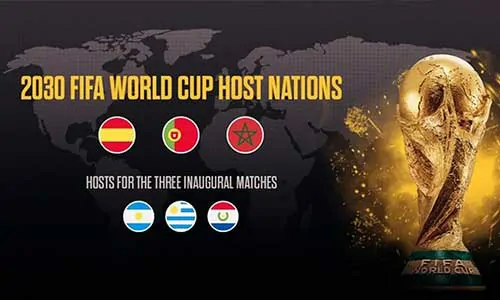
Furthermore, the 2030 World Cup is set to push boundaries even further. The tournament’s matches will be played across three continents—Europe, Africa, and South America—to celebrate the centenary of the first World Cup in Uruguay. While this approach offers unique opportunities for cultural exchange, it also introduces unprecedented logistical challenges regarding travel and scheduling.
Looking ahead, Saudi Arabia has emerged as the sole bidder for the 2034 tournament, following FIFA’s decision to limit bidding to member associations from Asia and Oceania. Consequently, future hosts will rely heavily on the standardized FIFA World Cup host selection process to prove their capability to manage such a massive global event under intense international scrutiny.
6. Bidding Requirements Comparison: Past vs. Present
To better understand how the FIFA World Cup host selection process has evolved, let us compare the administrative and logistical requirements of different eras:
| Feature / Requirement | The Classic Era (1930 – 1998) | The Modern Era (Post-2018 Reforms) |
|---|---|---|
| Voting Body | FIFA Executive Committee (approx. 24 people) | FIFA Congress (all 211 member associations) |
| Vote Transparency | Secret ballot with no public record | Publicly registered, auditable digital votes |
| Human Rights Auditing | Not considered in the official guidelines | Mandatory risk assessments and independent reviews |
| Technical Evaluation | Informal visits; recommendations were non-binding | Strict, points-based scorecards (bids can be disqualified) |
| Joint Bids Policy | Discouraged (except for Korea/Japan 2002) | Actively encouraged to manage 48-team scale |
7. Frequently Asked Questions (FAQ)
Q1: How has the FIFA World Cup host selection process changed over time?
Originally, hosts were chosen via informal agreements, political lobbying, or small committee votes. Today, it is a highly transparent process where all 211 member associations vote publicly, following rigorous technical, human rights, and environmental audits.
Q2: Who votes on the host country for the World Cup?
The final decision is made by the FIFA Congress, which is composed of all member associations. Each country’s football association receives one vote, and the individual votes are published transparently after the ballot.
Q3: Can a country be disqualified from bidding?
Yes. If a bidding nation fails to meet the minimum requirements during the technical evaluation phase (e.g., transport, infrastructure, or human rights standards), the FIFA Council can disqualify the bid before it reaches the voting stage.
Q4: Why are joint bids becoming more common?
Since the World Cup expanded to 48 teams, the logistical and financial strain on a single host is immense. Joint bids allow neighboring countries to share costs, utilize existing stadiums, and minimize environmental impact.
Q5: What are the main criteria for hosting a World Cup?
The main criteria include stadium infrastructure, transport networks, accommodation, security, environmental sustainability, and a clear commitment to international human rights standards.
Q6: How does FIFA ensure the voting process is fair?
FIFA uses independent auditing companies to monitor the process, strictly enforces codes of ethics that ban gifts or developmental aid, and makes every vote public to prevent behind-the-scenes collusion.
Ultimately, the FIFA World Cup host selection process has come a long way from its humble, closed-door beginnings. As the tournament continues to grow, balancing economic opportunity with social responsibility remains a key challenge. However, the modern reforms have successfully established a more democratic, accountable, and transparent framework for choosing future hosts.
As the FIFA World Cup Host Selection Process: Evolution Through the Years demonstrates, the journey of selecting a host nation is as dynamic as the sport itself. What are your thoughts on multi-continent hosting? Join the conversation in the comments below, or share this article with fellow football fans to keep the debate alive!